A rep fumbles the pricing objection on Tuesday's call. The manager has a free slot on Thursday. The rep doesn't book it, so nobody learns what went wrong.
Reps who need feedback most tend to ask for it least. AI Sales Roleplay lets a rep rehearse a customer call, objections included, against an AI buyer. It can drill a weak spot only after someone names it. For sales managers, L&D leaders and enablement teams tired of coaching only the reps who volunteer, the process breaks before the first question gets asked.
Why Don't Salespeople Ask Managers for Feedback?
Because asking costs more than it pays. Managers who dodge hard conversations teach struggling reps to stop asking, and reps who fear negative feedback start avoiding their managers. Each side reinforces the other's silence, and researchers call the result the feedback gap (Moss and Sanchez, Academy of Management Executive).
Nobody has to lie for this to work. Everybody just stays busy. By the pipeline review, no one can say which objection landed badly on last Tuesday's call. Silence isn't the same as a clean quarter.
The Paradox: AI Sales Roleplay Can't Drill What Reps Won't Name
Picture the rep who fumbled the pricing objection. Asking "what did I get wrong?" feels a lot like volunteering for a performance review. A scenario study tested how managers read that exact request. Managers credited an average performer's ask less to a wish to improve than a top performer's (de Stobbeleir, Ashford and Sully de Luque, Journal of Occupational and Organizational Psychology).
Put that beside the feedback gap and an uncomfortable inference follows. The reps with the most to fix may be the least willing to say so. That leaves AI Sales Roleplay with nothing to drill. A roleplay needs a target, and the target is a weak spot someone finally said out loud.
The scenarios weren't live sales teams, so treat this as a pattern, not a verdict. It does suggest that silence in a pipeline review isn't always confidence. Sometimes it's arithmetic.
Read more
>>> Why Skill Gaps in Sales Training Surface as Lost Deals
>>> Self-Paced Learning: Empowering Employees to Upskill
Not sure where to start? Book a free session with our team and we'll map out a solution built around your training goals.
Will Reps Ask AI What They Won't Ask a Manager?
Research suggests they might. In a USC study, people who believed an automated system was interviewing them reported less fear of self-disclosure and less impression management (Lucas et al., Computers in Human Behavior, via USC Institute for Creative Technologies). The participants weren't salespeople, so the sales takeaway is our inference, not the researchers' finding.
The study, titled "It's Only a Computer," put participants through a clinical interview with a virtual human. Everyone met the same interviewer. Some were told a person was controlling it, and others that it was fully automated. The automated group shared more openly, sadness included.
Only the belief changed, not the interviewer. Swap the clinic for a sales floor and the fear likely stays the same: judgment. Remove the human judge and a hard question gets cheaper to ask. A rep can then ask "where did I slip?" before the one-on-one, not instead of it.
That gives AI Sales Roleplay a starting point: the weak spot the rep was finally willing to name. The question didn't get easier. It got cheaper.
From a Safe First Question to AI Sales Roleplay

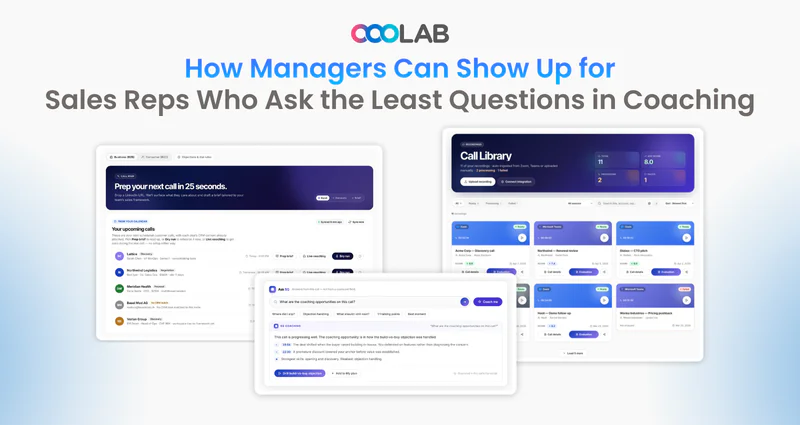
Skill Quotient AI, part of OOOLAB's LearningOS, puts that first question inside the call record. It scores each call against your own sales playbook, and Ask SQ lives inside every scored record. A rep taps a starter question like "Where did I slip?" and gets an answer with timestamps pointing to the exact moments.
Beside the answer sits a button to drill that objection in AI Sales Roleplay. That makes the loop three steps long:
Ask: a starter question, or anything else
Answer: pulled from that call, with timestamps
Drill: that objection, in AI Sales Roleplay
A scheduled review asks a rep to volunteer a weakness. A starter question asks for nothing of the sort. The answer comes from the call, not the rep's memory of it, and no calendar invite is involved. Knowing an objection isn't the same as rehearsing it, so AI Sales Roleplay sits one button away. That's how a good intention becomes practice.
Read more
>>> AI Sales Roleplay: The Missing Link Between Training Investment and Revenue Results
>>> The Benefits of Role-Playing in Sales Training and How to Implement It
What Managers Still Own Once AI Sales Roleplay Starts
Managers still own judgment, context and the next career move. The AI answer is the first question, asked cheaply. AI Sales Roleplay is the rep's next move, and the manager conversation comes second. It improves when the rep arrives with a timestamp instead of a shrug.
An AI Powered LMS isn't there to replace the one-on-one. It's there to make the one-on-one worth booking. Effective sales training isn't a course plus a hope but a question, an answer and a rehearsal, repeated. Three habits help managers support that loop:
Ask what the rep asked the call
Open with the timestamp, not the verdict
Thank the question before grading the answer
The best one-on-one starts with the rep's question, not the manager's verdict.
Conclusion
Your quietest reps aren't the least curious. They're the ones doing the math on what asking costs. Give them a first question that costs less, an answer tied to a timestamp, and AI Sales Roleplay for what comes next. Once the first question is cheap, the second one gets easier.
Ready to see AI roleplay and assessment in action? Book a free Skill Quotient AI demo and watch your team's training performance shift.
About Us
At OOOLAB (pronounced "u:laeb"), our mission is to make complex learning operations simple. We aim to positively impact the lives of over 1,000,000 learners and educators by the end of 2026. OOOLAB's LearningOS provides educational institutions and corporate enterprises with an all-in-one solution to create and deliver engaging learning experiences.
Dedicated success manager
Personalized setup
Ongoing assistance
Learn more at thelearningos.com