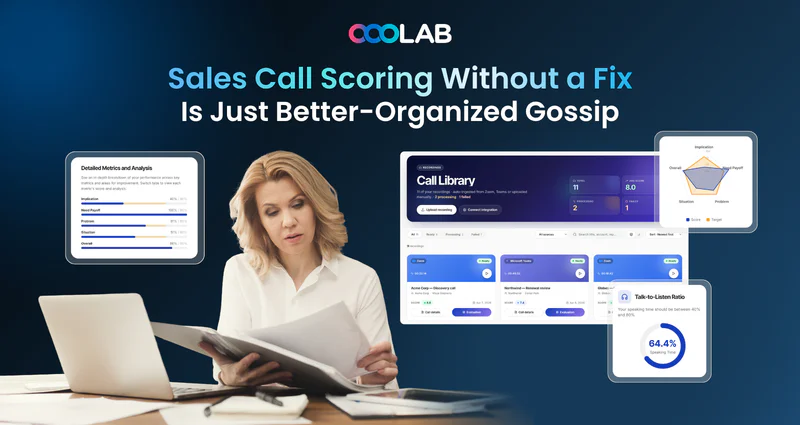
Monday morning. A sales manager opens a dashboard full of scored calls. Every call has a number next to it. None of them says what the rep should do differently next time.
That's the catch with scoring every call. It fixes the coverage problem. It doesn't fix the coaching problem. If you manage reps, or support the people who do, you've probably seen this dashboard. A score only counts assales training once it changes what a rep does on the next call.
Does Scoring Every Sales Call Fix Sales Coaching?
Not by itself. Scoring every call fixes who gets reviewed. It doesn't fix what happens afterwards. Managers get a bigger pile of calls to sort through. Reps still wait for the next coaching conversation to hear how they're doing.
The data points the same way. In Salesloft's 2025 Sales Skills Gap Survey of 100 frontline sellers and managers, 94% of managers said coaching is part of their regular process. Yet 53% of sellers said they're coached quarterly or less. And 37% said they rarely or never get personalized feedback (Source:Salesloft via SalesTech Star, 2025).
Nobody in that survey is lying. Managers do coach, but they don't have the hours to coach every rep on every call.
A CSO Insights study found that a formal coaching process lifted the number of reps hitting quota by 10%. Win rates on forecast deals rose 28% (Source:Training Industry, 2016). It's an older study, so treat the figures as a guide.
What Is Sales Call Scoring in Sales Training?
Sales call scoring is the practice of grading each customer conversation against a defined standard, such as your sales playbook. It returns a score for each skill or stage. Insales training it only helps when the score points to a specific moment in the call and says what to change.
A bare number can't do that. A rep who sees 62 out of 100 asks the obvious question: which part? If the system can't answer, the manager ends up scrubbing through the recording to find out. It's the same workflow as before, with a dashboard on top.
Not sure where to start?Book a free session with our team and we'll map out a solution built around your training goals.
When the Score Becomes the Goal
There's a second problem, and economists have known about it for decades. In Marilyn Strathern's 1997 wording of Goodhart's Law, when a measure becomes a target, it stops being a good measure (arXiv preprint). Charles Goodhart's own 1975 version was drier: any observed statistical regularity tends to collapse once pressure is placed on it for control purposes.
Applied to sales, that's a rep who learns what the scorecard rewards instead of how to run a better call. We haven't found a study showing AI call scores get gamed, so treat it as a risk, not a proven result. The usual defense is several metrics, so no single number is worth chasing (DevIQ). Tying the score to a playbook the team already agrees on helps too.
Read more
>>>Why Skill Gaps in Sales Training Surface as Lost Deals
>>>AI Sales Roleplay: The Missing Link Between Training Investment and Revenue Results
What Makes a Call Score Usable for Sales Training?
A usable score comes with five things attached. It shows the moment the call turned and the exact line the rep said. It suggests a fix, arrives before the next call, and measures against your own playbook instead of a generic checklist. Without them, the score never becomes sales training. The rep is back to guessing.
Skills Quotient AI, OOOLAB's AI sales call scoring tool, works this way. It grades each customer call against your playbook, points to the moment that mattered, and has the verdict ready before the rep closes the laptop. Feedback that arrives three weeks later is a history lesson. Feedback from this morning's call can still be used this afternoon.
What Is the Score Measured Against?
A score is only as fair as the standard behind it. Grade calls against a generic checklist and your sales training coaches reps to sell like a generic team. Grade them against your own sales playbook and the number reflects how your team actually sells.
None of this means dropping SPIN, MEDDICC or Challenger. They work well as lenses, each reading the same call from a different angle. The playbook is the standard; the frameworks help you look at it. That leaves a question most teams skip. If every call is scored against the playbook, who checked that the playbook is right?
What Should Sales Training Track Instead of Calls Reviewed?
Skill movement. Calls reviewed is the completion rate of sales coaching: it shows activity, not capability, and L&D teams already learned that lesson with courses.Effective sales training shows whether a skill improved after the feedback and whether the rep got to practise it.
Three measures cover most of it:
Skill score trend per rep, call over call
Time from call to feedback
Flagged moments that were practised, not just read
Then connect them to the numbers finance already reads: win rate, ramp time and quota attainment. That link shows what your sales training is worth, and it keeps scoring from turning into a reporting exercise.
Read more
>>>Training That Proves Its Worth: How to Connect L&D Programs to Measurable Business Outcomes
>>>How Role-Playing in Sales Training Benefits Sales Enablement Goals
Conclusion
Scoring every call is the easy part, and most tools can produce a number. The harder part is attaching the moment, the line, the fix and the standard. Then all of it has to reach the rep while the call is still fresh. Without that, a scored call is still just better-organized gossip.
Ready to see AI roleplay and assessment in action?Book a free Skills Quotient AI demo and watch your team's training performance shift.
About Us
At OOOLAB (pronounced "uːlæb"), our mission is to make complex learning operations simple. We aim to positively impact the lives of over 1,000,000 learners and educators by the end of 2026. OOOLAB's LearningOS provides educational institutions and corporate enterprises with an all-in-one solution to create and deliver engaging learning experiences.
Dedicated success manager
Personalized setup
Ongoing assistance
Learn more atthelearningos.com