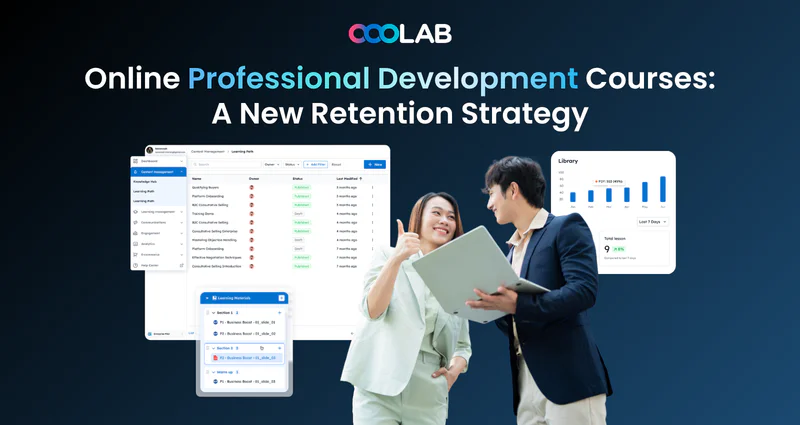
Let’s face it: Professional development still sits in the same budget line as gym stipends and snack subsidies at most companies. That placement is starting to look like a mistake. Employees who feel their company invests in their growth are far more likely to stay. The gap between firms that treat learning as infrastructure, and firms that treat it as a perk, is widening every year.
For L&D leaders defending a budget line in front of their finance department, this shift matters more than any number of engagement surveys. A professional development LMS is one of the few levers with a direct, measurable line to retention.
The Perception Gap: Why PD Still Gets Treated as a Perk
Ask most HR teams to list their benefits, and professional development LMS access usually shows up somewhere between wellness apps and free coffee. That framing made sense when training budgets were flush and retention was not a board-level concern. It makes far less sense now.
The problem is not that companies dislike training. It is that professional development (PD) gets budgeted like a nice-to-have, reviewed like a nice-to-have, and cut like a nice-to-have the moment finance asks hard questions. Meanwhile, the data connecting learning access to whether people stay keeps getting harder to ignore.
The language around a professional development LMS needs to change first. Calling something a perk signals it is optional. Calling it a retention strategy signals something different. It ties learning to a business outcome finance already cares about, and that reframing changes how the next budget conversation goes.
Does Professional Development Actually Improve Employee Retention?
Employees who believe their company invests in their growth are 90% more likely to stay (Source: LinkedIn Workplace Learning Report, 2025). That single number reframes the entire conversation. It is not a soft engagement metric. It is a direct predictor of who walks out the door, and a professional development LMS is what turns that predictor around.
The gap widens further when you look at learning culture specifically. Organisations with a strong learning culture report 57% retention, compared to just 27% at companies with a moderate one (Source: LinkedIn Learning). Here's why that matters: losing an employee typically costs a meaningful share of their annual salary in replacement and ramp-up time. Aprofessional development LMS that keeps even a handful of additional people each year pays for itself several times over.
Read more
>>> IQ, EQ, and SQ: Skill Quotient as the New Workforce Metric
If retention and engagement are a priority for your team, start here and see how LearningOS delivers both.
Signs Your Team Lacks Real Development Access
Most organisations already offer some form of training. The question is whether it actually functions as development. A few patterns tend to show up before attrition does, especially without a real professional development LMS in place:
No visible growth path beyond the current role
Training limited to mandatory compliance content
High performers going quiet in one-on-ones
A generic professional development LMS with no connection to individual skill gaps
No way to tie completed learning to career or performance outcomes
None of these look dramatic in isolation. Together, they describe a workforce that experiences learning as a checkbox rather than a career lever. Left unaddressed, that pattern shows up later as attrition among exactly the people a team can least afford to lose.
Why Budget Scrutiny Makes This Harder to Ignore

L&D leaders are not imagining the pressure. The cost per formal training hour rose 34% year over year to $165 in 2024 (Source: ATD via SeerTech, 2026). Meanwhile, large enterprises trimmed average training spend from $16.1 million to $13.3 million. Organisations are paying more to deliver less, and that is precisely the environment where a generic professional development LMS gets cut first.
That is also why vague justifications no longer work in the budget conversation. Per LinkedIn's 2026 Workplace Learning Report, 67% of L&D leaders struggle to demonstrate training impact to their executives. Completion rates and course counts do not survive a serious CFO review. Retention numbers, attrition, cost avoidance, and skills-readiness metrics do. A professional development LMS that reports on all three closes that gap.
What a Retention-First Professional Development LMS Looks Like
A professional development LMS built for retention looks different from a generic course catalogue. It combines structured, role-relevant learning paths with analytics that tie completed training back to retention and performance, not just click-through rates.
LearningOS clients report 30 to 50% higher employee retention and 40 to 60% less training time. Both run from a single learner record instead of a patchwork of disconnected tools. Bring your professional development LMS to a new height with LearningOS. That single dataset is what makes it possible to show, in one dashboard, whether development access is actually changing who stays.
Read more
>>> How Can an LMS Help Automate My Learning Operations?
>>> Mid-Year Sales Training Reset: A Playbook for Q3 Performance
Building the Business Case for a Professional Development LMS
Making the case for a professional development LMS to a CFO starts with dropping the word "perk" entirely. Replace it with a specific, defensible metric instead. Use the cost of replacing a departing employee, the current attrition rate among high performers, or the retention gap between well-trained and undertrained teams.
Pair that number with a structured development path anchor, something a CFO can visualise rather than a vague promise. Show what happens when access expands, not just what it costs. The organisations winning this argument are not asking for more budget. They are reframing existing spend as a measurable retention lever, backed by a professional development LMS that can prove it.
Conclusion
Professional development is no longer a line item to defend once a year. It is one of the clearest retention levers L&D leaders have, and the data now backs that up directly. The organisations that move first will retain the people their competitors are still trying to replace.
Built for L&D leaders who need results, not more admin. Book your free demo and bring your learning operations up to speed.
About Us
At OOOLAB (pronounced "u:laeb"), our mission is to make complex learning operations simple. We aim to positively impact the lives of over 1,000,000 learners and educators by the end of 2026. OOOLAB's LearningOS provides educational institutions and corporate enterprises with an all-in-one solution to create and deliver engaging learning experiences.
Dedicated success manager
Personalized setup
Ongoing assistance
Learn more at thelearningos.com