41% of executives still view L&D as a cost rather than an investment, even as U.S. corporate training spend hit $102.8 billion in 2025 (Source: TalentLMS L&D Report, 2026; Training Magazine, 2025). The money is there. The credibility isn't.
That gap isn't a budget problem, it's an architecture problem. Programmes designed around completions and satisfaction scores will always look like overhead to a CFO. Programmes designed around four specific business outcomes will not. A Learning & Development LMS is the operational infrastructure that connects training activity directly to workforce performance data, using a four-layer framework.
Why L&D Gets Stuck in the Cost-Centre Trap
75% of HR managers say their strategy is aligned with business KPIs (Source: TalentLMS L&D Report, 2026), yet 41% of executives still see L&D as a cost. The gap comes down to measurement: programmes tracked by completions and satisfaction scores will always look like overhead, because those metrics don't speak the language of business performance.
An L&D team that delivers 94% course completion still gets asked whether sales numbers improved, with no data connecting the two. That's not a reporting failure, it's a design failure: the fix is building a clear line of sight to outcomes from the start.
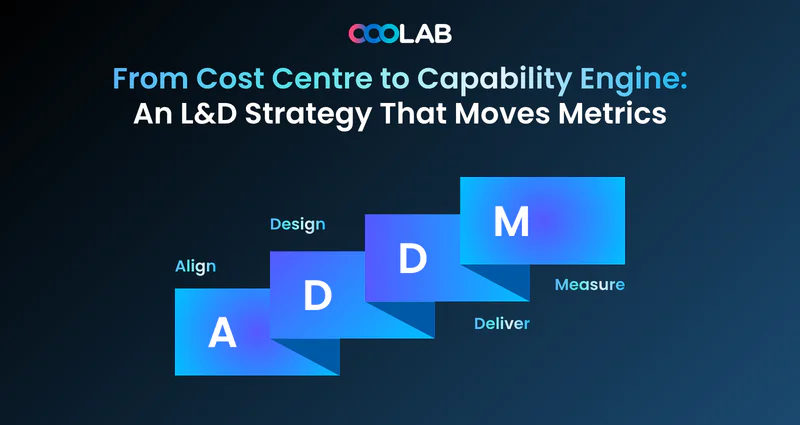
The L&D Strategy Stack - A Four-Layer Framework
The L&D Strategy Stack is OOOLAB's four-layer framework for building an L&D function that produces measurable business results, with each layer mapping directly to a platform capability so strategy and your Learning & Development LMS operate as one system. 
Here's how each layer works:
Layer 1 - Align: Define workforce readiness as a measurable outcome and establish your competency baseline before training is designed.
Layer 2 - Design: Build programmes around the outcomes you need to move, like retention and internal mobility, not content availability.
Layer 3 - Deliver: Deploy training through a platform that meets employees where they are, with personalised paths that compress ramp time.
Layer 4 - Measure: Track time-to-proficiency, skill growth velocity, and compliance coverage, not completion rates.
Built for L&D leaders who need results, not more admin. Book your free demo and bring your learning operations up to speed.
Layer 1 - Align: Workforce Readiness as a Measurable Outcome
Workforce readiness is a business metric, not a training goal: the percentage of your workforce performing at the competency level their role requires. ACapability LMS makes this visible by tracking skill gap assessments, competency completion, and time-to-proficiency by role, not just course completion.
63% of employers cite skills gaps as the biggest barrier to business transformation (Source: Training Orchestra, 2026), and in most organisations it's a visibility problem, not a hiring one. When an L&D director finds 40% of new hires missing baseline proficiency within 60 days, the right LMS analytics turn that anecdote into an actionable finding, pinpointing exactly which modules and cohorts are falling behind.
Read more
>>> 5 Reasons Why you should choose a SaaS for your LMS
>>> How to Leverage LXP Learning Analytics to Increase ROI
Layer 2 - Design: Employee Retention as a Training Outcome
Retention and L&D strategy aren't separate programmes. 90% of employees are more likely to stay at a company that invests in their growth (Source: LinkedIn Workplace Learning, 2025), and organisations with strong learning cultures see 30-50% higher retention (Source: Clarity Consultants/Brandon Hall Group, 2026). Your Professional Development LMS architecture is a direct input to that number.
Designing for retention means building visible development paths, not just assigning courses, so employees can see what roles and certifications their learning leads toward. A platform with structured career pathways and internal mobility tracking turns L&D from a training calendar into a career architecture.
Read more
>>> Effective Onboarding Strategies for New Sales Hires: Setting Them Up for Success
Layer 3 - Deliver: Time-to-Productivity as a Training KPI
New hire ramp time and internal transfer transition cost are among the most quantifiable, and most underreported, L&D impact areas. Every week a new employee isn't at full productivity is a cost. The Deliver layer is where your AI LMS reduces both.
LearningOS clients report 40-60% less training time than traditional delivery, through AI-assigned paths based on role, prior competency, and skill gaps that cut the irrelevant modules generic course catalogues add. Track completion velocity, first-attempt pass rates, and manager-confirmed readiness against your onboarding timeline to make this measurable.
Layer 4 - Measure: Compliance Risk Reduction
Compliance training isn't just a legal obligation, untracked compliance is a quantifiable financial risk. The right frame for leadership isn't course completion rates, it's reduced regulatory exposure with an audit trail to prove it.
That reframe positions L&D as a risk management function, a budget case that survives any downturn. LearningOS is SOC 2 Type 2 and ISO 27001 certified, meeting the same compliance bar it helps your organisation achieve. Track certification expiry, overdue alerts, and audit-ready, timestamped reporting to convert compliance training into risk-reduction evidence.
What the Full Strategy Stack Looks Like in Practice
Each layer maps to a specific LearningOS capability: Align uses competency frameworks and skill gap assessments, Design uses personalised career pathways, Deliver uses the Virtual Learning Environment and Mobile Learner Portal, and Measure uses the analytics dashboard linking training to performance.
The result is one platform, one learner record, and one line of sight from training activity to outcome. Organisations aligning L&D around skills see up to 40% higher productivity (Source: McKinsey), with LearningOS clients reporting $3.5 ROI on every dollar invested and 30-50% higher retention.
Read more
>>> AI Sales Roleplay: The Missing Link Between Training Investment and Revenue Results
Conclusion
L&D's shift from cost centre to capability engine is a design question, not a budget one. Organisations achieving it build platforms around business outcomes, not training delivery. The four-layer L&D Strategy Stack gives your team the architecture, and the language, to make that case before your next budget review.
Built for L&D leaders who need results, not more admin. Book your free demo and bring your learning operations up to speed.
About Us
At OOOLAB (pronounced "uːlæb"), our mission is to make complex learning operations simple. We aim to positively impact the lives of over 1,000,000 learners and educators by the end of 2026. OOOLAB's LearningOS provides educational institutions and corporate enterprises with an all-in-one solution to create and deliver engaging learning experiences.
Dedicated success manager
Personalized setup
Ongoing assistance
Learn more at thelearningos.com