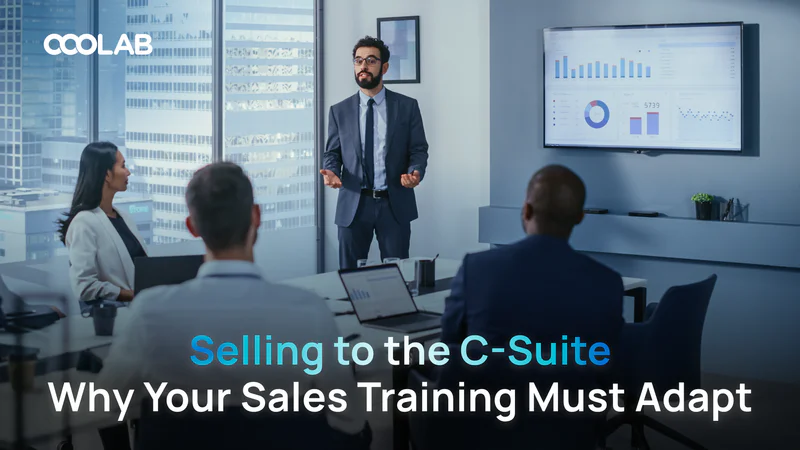
Selling to the C-suite means pitching a room of stakeholders instead of one buyer; it demands business-case fluency, financial storytelling, and multi-stakeholder navigation that standard sales training was never built to teach.
The average enterprise buying committee has grown to 11 stakeholders, up from just 7 in 2017 (Source: Gartner, 2024). Reps trained to pitch a single buyer freeze the moment a CFO or CEO joins the call. Closing an executive deal is not a bigger version of a standard deal, it is a different motion built on business-case fluency and multi-stakeholder navigation.
This blog explores how sales training has to change once your buyer sits in the C-suite, supported by data-driven insights.
The Executive Deal Is a Different Sport
Selling to the C-suite means selling to a room, not a person. Buying committees now average 11 stakeholders for enterprise software purchases, and deals above $1 million routinely involve 14 to 23 people across finance, legal, and operations (Source: Forrester, 2023). Reps who prepare a single-buyer pitch are outnumbered before the call even starts.
That complexity has a direct cost. Deals with 10 or more stakeholders take 47% longer to close and require 3X as many touchpoints (Source: McKinsey, 2024); and teams that actively map their stakeholders, see it pay off. Deals where six or more stakeholders are mapped in the CRM close at a 34% win rate, compared to 11% when fewer than three are tracked (Source: The Starr Conspiracy, 2024). Reps who can identify and navigate a complex, multi-stakeholder deal early have a measurable edge over reps who wait for the committee to reveal itself.
Why Does Standard-Cycle Sales Training Fall Short at the C-Suite?
Most sales training builds reps for a linear path: discovery, demo, proposal, close. Executive deals do not follow that path. Committees experience unhealthy internal conflict 74% of the time during the buying decision, and sellers are rarely in the room when that friction happens (Source: Gartner, 2025). A rep trained only to handle objections from one buyer has no playbook for aligning finance, IT, and operations around a single "yes."
The gap shows up in numbers reps can feel. Only 81% of sellers say understanding a company's financial performance is critical to engaging executives, yet just 72% report they are actually successful when they use financial data in their conversations (Source: Databook, 2023). The distance between knowing it matters and being able to do it is exactly what standard-cycle training leaves unaddressed.
Read more
>>> Effective Onboarding Strategies for New Sales Hires: Setting Them Up for Success
>>> Sales Training in the AI Era: Building the Skills Reps Actually Need
Built for L&D leaders who need results, not more admin. Book your free demo and bring your learning operations up to speed.
The Skill Layer Executive Selling Actually Requires
Executive selling is a distinct competency, not an advanced version of discovery calls. It demands three specific skills: building a defensible business case, speaking the language of ROI and margin, and navigating a committee whose members do not always agree with each other.
This is where Competency and Skill frameworks matter more than generic coaching. A rep can be excellent at consultative questioning and still stall at the C-suite if they cannot translate a feature into a line on a P&L statement. Training programs that isolate executive selling as its own skill track, rather than folding it into general sales enablement, give reps a clear standard to work toward instead of assuming the skill will develop on its own.
Enterprise sales leaders who treat executive selling as a bolt-on to existing curriculum tend to see the gap resurface every time a new rep is promoted into strategic accounts. Building it as a standalone competency, with its own benchmarks and practice cadence, keeps the skill from eroding between deals.
Business-Case Building: Teaching Reps to Speak CFO
Three things that change when your buyer is a CFO:
Every claim needs a number attached, even in the first meeting; CFOs assume sellers can produce reasonable estimates on demand
The conversation shifts from product capability to margin, cash flow, and growth rate
Silence is not neutral; a CFO who is not given quantified impact treats the pitch as unfinished

Reps do not need a finance degree to clear this bar. They need repeatable frameworks for reading a balance sheet, tying a solution to a specific financial line item, and rehearsing that translation until it is second nature rather than improvised.
Practicing Executive Conversations Before They Count
Executive conversations are unscripted, so scripted practice does not prepare reps for them. Top-selling reps run twice as many practice roleplays as their peers (Source: Mindtickle, 2026), and that gap compounds when the scenario is a CFO pushing back on an ROI number instead of a familiar product objection.
Skill Quotient AI, OOOLAB's AI-powered roleplay and assessment tool, gives reps a safe environment to rehearse exactly this kind of pressure. Instead of a generic buyer persona, reps can practice against a simulated CFO or CEO who probes for numbers, challenges assumptions, and does not soften the questions the way a peer AI Sales Roleplay partner might.
Your Next Executive Deal Starts With How You Train Today
Executive-level deals will keep growing in size and complexity as buying committees expand. Reps who rehearse business-case conversations, learn to navigate conflicting stakeholders, and practice under real pressure walk into the boardroom prepared instead of hopeful. The sales training decisions your team makes now determine whether the next C-suite deal closes on your terms.
Organisations around the world trust LearningOS to run their training at scale. Book a demo and see why.
About Us
At OOOLAB (pronounced "uːlæb"), our mission is to make complex learning operations simple. We aim to positively impact the lives of over 1,000,000 learners and educators by the end of 2026. OOOLAB's LearningOS provides educational institutions and corporate enterprises with an all-in-one solution to create and deliver engaging learning experiences.
Dedicated success manager
Personalized setup
Ongoing assistance
Learn more at thelearningos.com