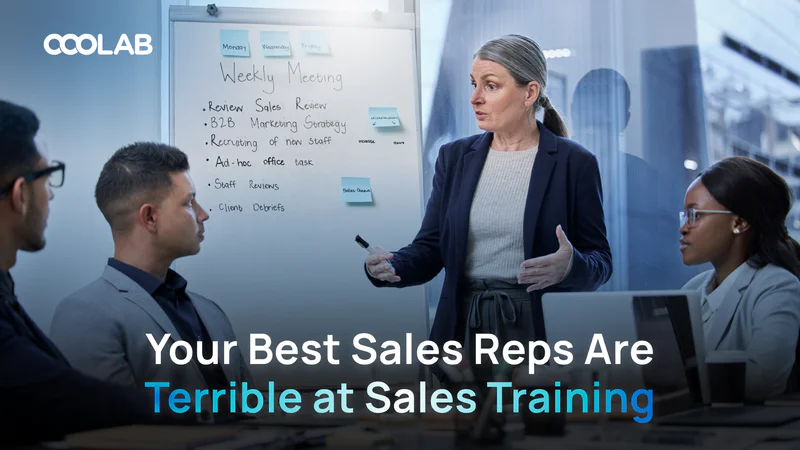
Every quarter, some poor new hire gets handed a headset, sits next to the top closer, and is told to "just watch and learn." It's the oldest move in the onboarding playbook, and it barely works. Psychologists have a name for why: unconscious competence, the fourth stage of Noel Burch's four-stage learning model, where a skill becomes so automatic the person doing it can no longer explain how they do it (Source: The Leader Lab). Your star rep isn't hoarding secrets on purpose. They genuinely cannot tell you why the deal closed. That's the uncomfortable truth sitting underneath most sales training programs today: the person you picked to teach it is the person least equipped to teach it. This article explores why shadowing fails at sales training, and what a data-derived alternative looks like.
The Unconscious Competence Trap Killing Your Sales Training
Burch's model runs through four stages: you don't know what you don't know, then you know what you don't know, then you consciously grind through the skill, and finally it becomes second nature (Source: Toolshero). Coaching works best from stage three, when someone still has to think about what they're doing and can narrate it. Stage four is where instincts live, not instructions.
Here's why that matters for your sales training program. Your top rep operates almost entirely on instinct now. Ask them why a deal closed and you'll get a shrug, a vibe, maybe "I just read the room." That's not false modesty. It's the honest limit of unconscious competence, and it's a lousy foundation for training anyone else.
Does Shadowing Top Sales Reps Actually Work?
Sales training is supposed to turn a new hire's first close into a repeatable skill, not a one-off fluke. Shadowing alone rarely gets you there. It gives new hires a front-row seat to a performance they can't reverse-engineer, delivered by someone who's usually too busy to actually teach (Source: HR.com). Your best rep is your best rep because they're closing deals, not because they have 3 hours/week free to babysit a rookie.
It gets worse. Shadowing passes down bad habits right alongside good ones, with zero structure and zero way to measure whether the new hire actually absorbed anything (Source: Allego). Managers walk away with no objective read on competency, just a hopeful assumption that osmosis happened. It usually didn't.
Poor onboarding is one of the fastest ways to lose new talent. Book a free call and learn how LearningOS helps your team ramp up faster.
Shadowing vs. Structured Sales Training: The Onboarding Scorecard
Lay the two approaches side by side and the gap is obvious:
One approach scales while the other one just hopes it does.
Read more
>>> Why Skill Gaps in Sales Training Surface as Lost Deals
>>> Beyond the Sales Floor: Why Sales Coaching Should Reach Every Team
What Call-Review-Derived Playbooks Actually Look Like
Instead of hoping talent rubs off, pull the pattern straight from the data:
Review your team's actual won and lost calls.
Identify the exact moves that separate the two: the objection response, the pivot to value, the question that opened up discovery (Source: Koncert).
Turn the pattern into a documented playbook, not a personality, a checklist.
Drill it through AI Sales Roleplay before reps touch a live call.
Companies with formal, structured sales training programs see 78% quota attainment, compared to 63% at companies without one (Source: RAIN Group). That gap doesn't come from a more charismatic mentor. It comes from documenting what works and drilling it.
Teams using AI-driven practice run new hires through dozens of simulated objection-handling scenarios in their first two weeks, versus five or six manager-led mock calls the old way (Source: Chambr, 2026). One team cut ramp time by 37% just by front-loading repetitions before reps went live.
Read more
>>> Sales Training in the AI Era: Building the Skills Reps Actually Need
>>> AI Sales Roleplay: The Missing Link Between Training Investment and Revenue Results
How Long Does Sales Training Ramp-Up Really Take?
Average ramp time for a new SaaS sales rep has stretched to 5.7 months, and 20% of new hires quit within the first 90 days, mostly because of poor onboarding (Source: SalesSo, 2025). Every one of those months is a month of quota that isn't getting hit.
The math scales fast: a 10% reduction in ramp time can add roughly $3.5 million in annual recurring revenue for a typical SaaS company (Source: Careertrainer.ai). That's not a training department win. That's a revenue line item, sitting unclaimed because the default move is still "go sit with Dave."
Conclusion
Your top performer earned that seat through years of instinct nobody asked them to document. That instinct is an asset, but it's not a sales training program, and treating it like one is costing you ramp time, quota, and new hires who quit before they ever get good. Build the playbook from the data instead. Let people who can still explain what they're doing teach the fundamentals, and let AI-driven practice handle the reps a human mentor never has time for.
Ready to see AI roleplay and assessment in action? Book a free Skill Quotient OS demo and watch your team's training performance shift.
About Us
At OOOLAB (pronounced "u:laeb"), our mission is to make complex learning operations simple. We aim to positively impact the lives of over 1,000,000 learners and educators by the end of 2026. OOOLAB's LearningOS provides educational institutions and corporate enterprises with an all-in-one solution to create and deliver engaging learning experiences.
Dedicated success manager
Personalized setup
Ongoing assistance
Learn more at thelearningos.com