Why do some reps consistently outperform despite having the same training, playbook, and manager?
The reality is: training isn't the problem; the practice is. And so is the lack of visibility into how that practice translates to real calls.
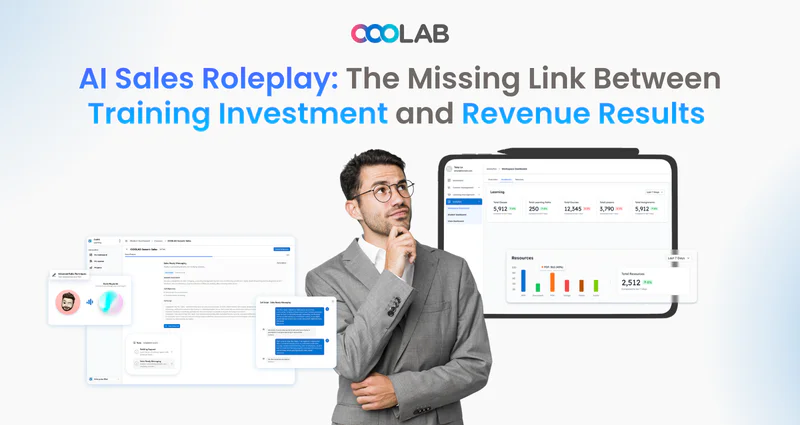
AI Sales Roleplay uses artificial intelligence to simulate buyer conversations, giving reps scored practice before a live deal is on the line. The same AI can also analyse a rep's real calls, measuring the gap between rehearsal and reality - the gap that decides whether training spend shows up in revenue. Reps lose up to 70% of training content within 24 hours without active recall (Source: Ebbinghaus Forgetting Curve, via DemandNexus, 2026).
This article covers both gaps - and the business outcomes that follow when you close them.
The Practice Gap - and the Gap Underneath It
Reps can pass every assessment and still revert to old habits when a real buyer pushes back. Without reinforcement, the forgetting curve erases up to 90% of training content within 30 days (Source: Richardson Sales Performance). RAIN Group's research shows companies with formal sales training see 78% quota attainment versus 63% without - a gap closed by structured practice, not better content.
But there's a second, rarely measured gap: rehearsal score versus real-call performance. A rep can ace a practice scenario and still freeze live, because rehearsal and reality aren't the same test. Closing the first gap without measuring the second tells you a rep can perform under simulated pressure - not whether they're doing it on calls that close revenue.
Read more
>>> The Benefits of Role-Playing in Sales Training and How to Implement It
How AI Sales Roleplay and Real Call Analysis Close Both Gaps
AI Sales Roleplay closes the first gap through repetition at scale, instant competency scoring, and adaptive scenario variation - mechanisms quarterly, manager-led roleplay can't match. Teams using AI-powered training are 35% more likely to report higher average deal size (Source: Highspot, 2025), and structured AI roleplay drives 11–28% win rate improvement (Source: Hyperbound AI, 2025).
The second gap needs real calls scored on the same framework - objection handling, discovery depth, deal progression - producing two comparable numbers: a practice score and a live-call score. A wide gap signals confidence, not skill. A narrow gap with low scores both ways means the rep needs more reps. Without measuring both, the two problems get identical, ineffective coaching.
Ready to see AI roleplay and assessment in action? Book a free demo and watch your team's training performance shift.
The Revenue Results - and Why the Gap Predicts Them
Enterprise teams implementing AI Sales Roleplay report 30% faster ramp times, 15–20% higher quota attainment in year one (Source: Gartner, 2025), and 11–28% win rate improvement (Source: Hyperbound AI, 2025). High-performing teams using structured AI coaching are 2.4x more likely to protect quota attainment through end-of-quarter pressure (Source: Salesforce State of Sales).
A shrinking practice-to-performance gap predicts these numbers before the quarter closes, not after. Reps whose live scores track their practice scores convert pipeline more predictably - linking the gap directly to quota attainment, win rate, and cycle length.
What Effective AI Sales Roleplay Requires - and How Skill Quotient OS Delivers It

Four components separate programmes that move revenue from those generating activity reports: realistic, adaptive buyer personas; scored feedback tied to specific competencies; spaced reinforcement across multiple sessions; and real call analysis scored on that same framework.
Skill Quotient OS - OOOLAB's AI roleplay and call analysis platform - is built around all four, putting rehearsal and live-call scores side by side. The biggest quota uplift comes from the middle 60% of the team - skilled but under-practiced - a cohort AI scales to in a way human-only coaching cannot (Source: Gartner, 2025). LearningOS supports 250,000+ learners across 23 countries.
Read more
>>> Building Confidence in Your Sales Team Through Training and Development
Measuring the Programme Against Revenue

Connect AI Sales Roleplay directly to revenue using five metrics: the practice-to-performance gap (the leading indicator), quota attainment rate, sales cycle length, win rate by cohort, and ramp time to first deal. Only 17% of organisations currently measure training ROI (Source: Sales Management Association / Training Industry Research). If you can't connect practice and real-call performance to pipeline outcomes, you're running a schedule, not a strategy.
Conclusion
AI Sales Roleplay isn't a feature upgrade on your LMS - it's a structural shift toward continuous, scored practice measured against real call performance. The teams closing more deals in 2026 are the ones who can see where rehearsal and reality diverge - and close that gap first.
See howSkill Quotient OS - OOOLAB's AI roleplay and call analysis platform - converts training investment into quota attainment.
About Us
At OOOLAB (pronounced "uːlæb"), our mission is to make complex learning operations simple. We aim to positively impact the lives of over 1,000,000 learners and educators by the end of 2026. OOOLAB's LearningOS provides educational institutions and corporate enterprises with an all-in-one solution to create and deliver engaging learning experiences.
Dedicated success manager
Personalized setup
Ongoing assistance
Learn more atthelearningos.com